The Lynching of Joe Adams
The lynching of Joe Adams on September 30, 1887, was the first in Nacogdoches County and set off sixteen years of lynchings in the county from 1887 to 1902. This lynching, which local Sheriff Andrew Jackson (John) Spradley failed to prevent, allowed a dangerous precedent of mob violence to grip the county and likely inspired Spradley’s efforts to prevent other lynchings (i.e., Esseck White in 1897 and Jim Buchanan in 1902). The lynching of Adams and the six more that followed in Nacogdoches County also contextualized and demonstrated the growing demographic and economic changes following the Civil War that saw increasingly more African Americans move to Nacogdoches, competing with whites for jobs, housing, and other resources amid a depressed but growing industrializing economy. Additionally, political turmoil in the county, state, and nation continued to spark fears in many whites who had already detested not only emancipation but also Reconstruction efforts to advance African American political and social rights. Specifically, in Nacogdoches, conflict raged between Sheriff Spradley, a Texas Populist who, along with his state and national cohorts, championed a modicum of African American civil and political rights, and local white Southern Democrats and their supporters over the establishment of Jim Crow segregation and racial oppression. Ultimately, while lynching in Nacogdoches County stopped, the Southern Democrats won, Populism died, and Jim Crow laws and oppression came to define life for the county’s African Americans far into the future. [1]
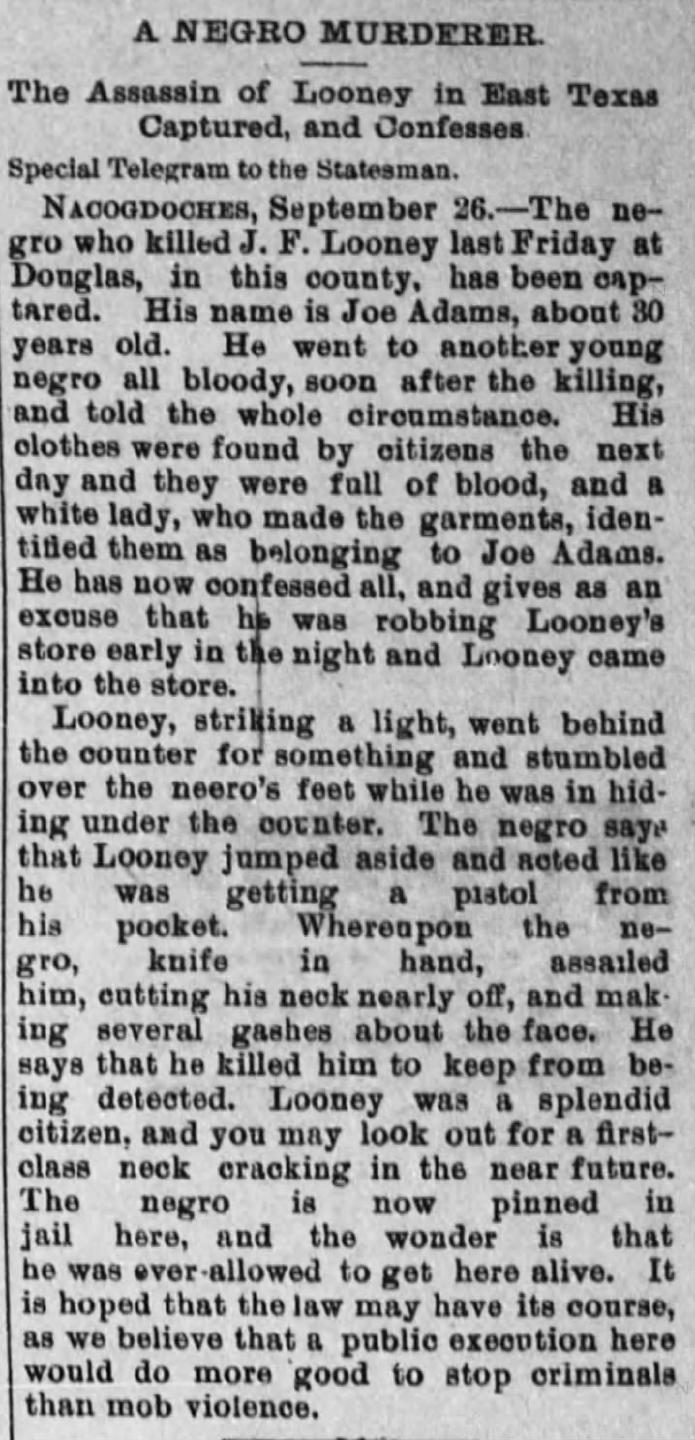
Joe Adams was accused of killing a shop owner named Joe F. Looney in Douglass, about 15 miles west of Nacogdoches City, and was lynched on the night of September 30, 1887. Newspapers described the murder of Looney brutally. Adams, supposedly caught by Looney while robbing his store, cut Lonney’s head almost completely off from his body. The white-led newspapers sensationally reported that Looney survived this near decapitation long enough to stumble out of his store and walk down the street before finally collapsing and bleeding out. Sheriff Spradley later found Adams, his clothes soaked in blood, after he allegedly fled the scene with an accomplice. A mob of about 150 masked men from Douglass, where Looney was a fixture of the community, marched to the Nacogdoches County jail in downtown Nacogdoches City, determined to lynch Adams. The mob first attempted to get the jail keys to Adams’s cell from the jailer, Owen Goff, then from Spradley himself. Spradley refused. But his resistance stopped there. He did not attempt to stop the lynch mob in any other way. Perhaps Spradley did not intervene out of fear of what the mob would do to him. Perhaps he feared for his career, or perhaps he did not truly believe that the mob would kill Adams. Regardless, Spradley failed to protect the man in his custody. [2]
To get to Adams, the mob used a makeshift battering ram to break into the jail (likely a pine log). They then started cutting into Adam’s cell with tools they either stole or received from the local blacksmith. The process took about an hour. An hour must have felt like an eternity for Adams as the safety of his cell slowly disappeared. The masked men who surrounded him were undoubtedly taunting and threatening him to boot. They wanted to kill him. And they got closer with each passing minute. The mob eventually cut through the cell bars. It dragged Adams to the public square in downtown Nacogdoches (near the current Nacogdoches Convention and Visitors Bureau), where they forced a confession. This provided the mob with all the legal evidence they needed to justify the impending lynching. But Adams also implicated another man, Tom Thorn. [3]
While Thorn was not lynched, he was notorious in the county already, and the implication of his involvement incited calls for his lynching as well. Eventually, the authorities arrested Thorn for attempted murder and sent him to Huntsville prison, and he died of unknown causes only six months later. [4] Whatever the case, they lynched Adams that night, hanging him from a chinaberry tree in the early morning hours.
Ultimately, Spradley proved powerless (or unwilling) to stop such a large and aggressive mob. But he doubled his efforts after the incident. For instance, though he was unable to prevent Esseck White’s lynching in 1897, Spradley called on the governor to send the militia and get Amos Phillips—a supposed accomplice of White’s—out of town. In 1902, Spradley attempted to hide Jim Buchanan from bloodthirsty mobs by taking him to Shreveport, then Henderson, and finally Rusk. While ultimately unsuccessful in preventing the lynchings of both White and Buchanan, Spradley did far more to prevent these than he did with Joe Adams’s. This change in his resolve may have come with guilt over his failure to protect Adams, but it is impossible to say for sure. Regardless, ultimately, the overwhelming power of mob rule overcame Spradley and his attempts to prevent lynching in Nacogdoches County. [5]
Images
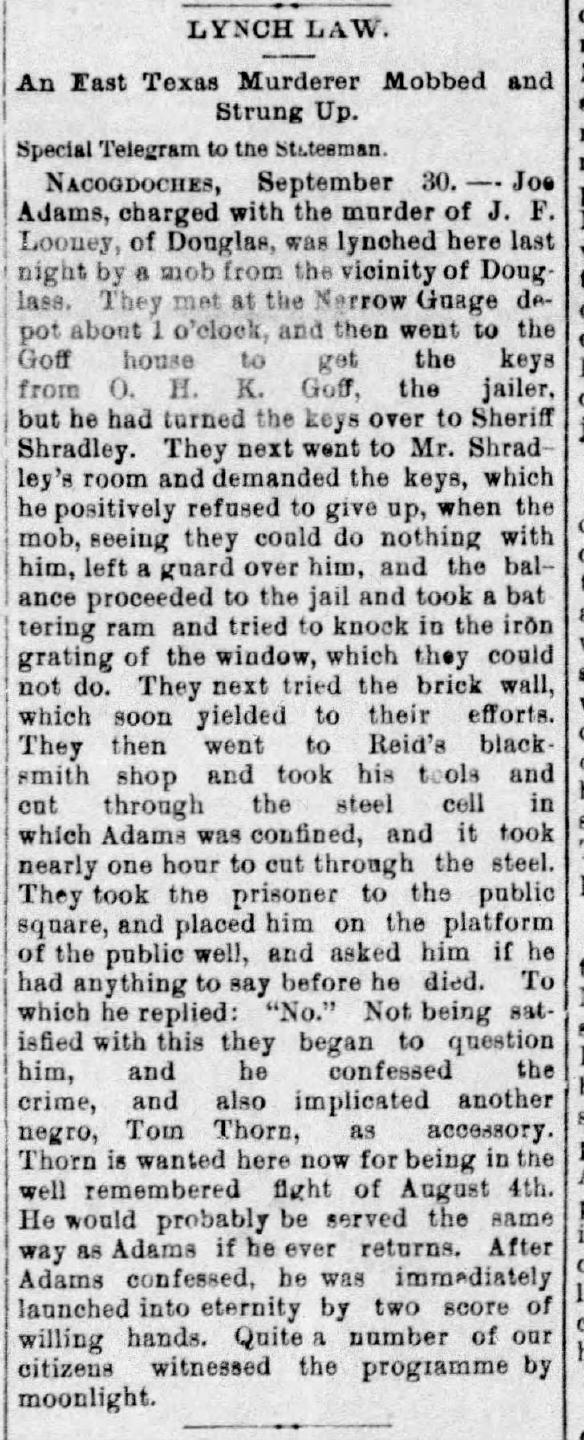
“Lynch Law,” Austin Daily Statesman, October 1, 1887, p. 1.
Date: October 1, 1887