Filed Under Political figures

Booker T. Bonner

Leader, Educator, Believer, & Observer

The story of Booker Thomas Bonner, generally known as B.T. Bonner, B.T. would begin his life in the town of rural Wallis, southwest of Houston, in 1927. Unlike G.J. Sutton or Moses LeRoy, Booner came from a non-leading family and was not originally a successful union leader like LeRoy himself. B.T. was a son of a sharecropper and seamstress who made ends meet; eventually, Bonner would be known as one of the state's most recognizable civil rights activists in 1963. The educational background of Booner would be sent away to school by his mother and eventually graduate from high school in Houston in 1944 before joining the service at the end of World War II. Bonner began attending Texas Southern University while using veterans' benefits but short-lived; B.T. would need to drop out of school to take care of himself when it came to the sudden passing of his mother in 1950. The death of B.T.'s mother would drive him to crave alcoholism and, eventually, send his well-being into a catastrophic state of having to recuperate from being run over by a car on a highway one late night. While attending the University of Texas, B.T. would find himself a cook job and begin working his way through school, majoring in history and government to become a successful teacher.


In 1960, Bonner was kindly invited to a "stand-in" movie theater on the university's drag, later to find out that both San Antonio and Austin Students for Direct Action (SDA) are corrupt. The SDA has similar intentions towards limiting members of all races by having them approach the ticket windows and then ask if the employees would sell tickets to all races. Eventually, Black students stood forced to go to the back of the line, and this process would be repeated countless times in one night. Bonner believed that this ideology of removing all races from attempting to attend a movie was obscured. With how abrasive B.T. indeed was when it came to being an observer and leader, he would try with the SDA leaders three times to let him into the movie theater. Later, he would be removed each time and try to be convinced by the SDA of their intentions towards all racial students. Given the circumstances of the 1960 stand-in movie theatre situation, Bonner would make himself predominantly known in his course for the ongoing desegregation struggle in March 1961. Booner would also stage a one-man hunger strike outside the Texas Theater that would last over sixty hours, making B.T. the lone wolf for challenging the SDA for the wrongdoing of treating Black students horribly. From this point, B.T. would be known as one the most radical Black in the state of Texas for drawing attention towards the SDA in demonstrating that any race should try to prevail upon a person's mind.


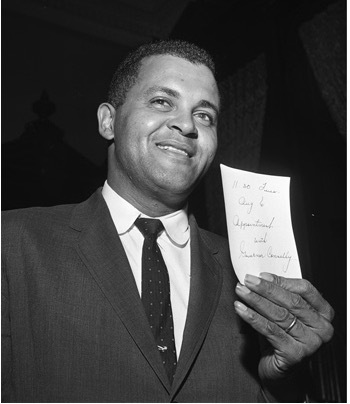
In 1962, like activists around Texas, Bonner supplemented his idea for civil rights activities by venturing into electoral politics. Bonner would also get involved with Don Yarborough's gubernatorial campaign for wanting a more established position within the political world. Oddly enough, Bonner would be proven to be a brilliant wildcard against white students, white liberal organizers, black ministers, and traditional elites when organizing African American civil rights and political action. Bonner and his pickets, composed of twenty students from the predominately white University of Texas, would protest outside Governor John Connally's office for wanting an eight-point set of civil rights proposals heard in the acceptance of a meeting by Connally himself. Surely enough, Bonner would get his appointment from Connally in 1963, around the same time that the Democratic Coalition was taking place in 1962-63.


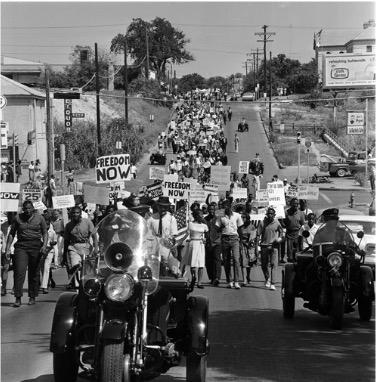
"The March on Austin" depended upon the ongoing vibrancy and salience of multiracial collaboration. Bonner wanted the governor to capitalize on removing racial references from all applications for state employment, immediately integrate state jobs, and withhold state funds from contractors who practiced discrimination. G.J. Sutton would question and criticize Connally on all accounts, bringing attention to the governor's hypocritical actions for involving himself with the United Political Organization (UPO). Bonner's character would be jeopardized, leaving him convicted of mail theft in 1945 at the early age of seventeen, forcing him to serve a three-year sentence in prison. Bonner would remain the undisputed leader of the March on Austin, eventually forming the Freedom Now Committee that would obtain a permit for a two-mile parade route from Rosewood Park in all-Black East Austin to rally in Wooldridge Park downtown.


In August 1966, when local elites refused to accept the job demands of Huntsville Action for Youth (HA-YOU), Bonner called on the youth organization to stage its protest march in front of the capitol. Like the Mexican Americans in the NFWA, the African Americans led by B.T. Bonner walked a thin line to highlight ongoing segregation and economic misery facing Blacks throughout East Texas. B.T. Bonner identified as also a leader of the Huntsville Demonstrations and staffer of SCLC, Bonner called out the white liberals for not truly being committed to the Black freedom struggle. B.T. reignited the black civil rights movement in Texas and also brought about tremendous pressure upon Governor Connally. Bonner's vital attributes are ambiguous class status, self-styled radicalism, and criticism of traditional black leaders. Bonner declared that he represented no organization, considered himself well to the left of the NAACP, and had no reason to disdain the UPO at all costs. B.T.’s succession in his rogue sit-in at the capitol had immediate political implications, especially regarding the ongoing debate between the more militant and conservative factions of African American leaders. Booker Bonner became a successful educator and leader in the military and throughout school, eventually following the footsteps of a civil rights activist. Booker Thomas Bonner would pass away at eighty-nine, and the burial site holds B.T.'s body in Harris County, Houston, at the Houston National Cemetery.

Video

Booker T. Bonner Conducts Sit-In Embedded within this video is a news segment for Houston's KPRC-TV broadcasted on July 30th, 1963. This video documents Booker T. Bonner's sit-in at the State Capitol and picketing outside the Governor's Mansion in Austin. As a member of the Freedom Now Committee, B.T. was an influential political figure in the Houston civil rights movement. Bonner also organized the demonstration after Connally stated that he did not support President John F. Kennedy's proposed public accommodation bill since it would violate traditional property rights. Booker spent countless days waiting outside Connally's office in the hope of talking to him about the civil rights situation. As Bonner's sit-in continued as time went on, the Capitol authorities would eventually remove his chair and force B.T. to move around the building. Source: info@texasarchive.org. 3908 Avenue B, Suite 105, Austin, TX 78751. Texas Archive of the Moving Image. Creator: Texas Archive of the Moving Image Date: July 30th, 1963.

Audio

KTSA Radio Broadcast Over Austin Civil Rights March They are recorded and produced by KTSA Radio, San Antonio, Texas, of the Austin Civil Rights March on August 28th, 1963. The tape begins with an interview by an unidentified KTSA reporter with Bob Joiner of the Indignant White Citizens Council (IWCC); 12:00 minutes: Booker T. Bonner; 34:08 minutes: an interview with Booker T. Bonner. Source: Trinity University Coates Library. KTSA (Radio Station: San Antonio, Texas.) Creator: Trinity University Coates Library Date: August 28th, 1963.

Images

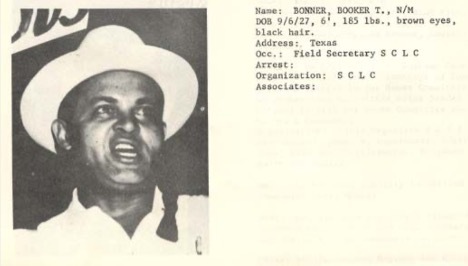
Booker T. Booner Background
Booker T. Booner Background Booker T. Bonner was born on September 6th, 1927. Bonner was well-recognized in the field of African American civil rights and wanted to promote an equal society among all racial backgrounds. B.T. was a son of a sharecropper and seamstress who made ends meet; eventually, Bonner would be known as one of the state's most recognizable civil rights activists in 1963. B.T. would be known as one the most radical Black in Texas for drawing attention towards the SDA in demonstrating that any race should try to prevail upon a person's mind. At eighty-nine, Booker Thomas Bonner passes away, carrying on the legacy of a true-born activist leader in forming the Freedom Now Committee. Source: Individuals Active in Civil Disturbances, volume 2. Alabama. Department of Archives and History. Digital Library of Georgia: Sharing Georgia’s History & Culture Online. https://crdl.usg.edu/record/aar_civildisturb2_1562?canvas=0&x=261&y=172&w=744 Creator: Digital Library of Georgia Date: 1965
Booker T. Bonner's Agreement With Governor Connally
Booker T. Bonner's Agreement With Governor Connally Iconoclastic activist Booker T. Bonner shows off a slip confirming his appointment with Governor John Connally in July of 1963. For more than two years after his one-man hunger strike landed him in the newspaper headlines, the sit-in at the capitol made Bonner the face of the state's civil rights movement. It would also place him at the centerpiece of the newly formed Democratic Coalition. With Bonner's determination to fight for civil rights and to establish his political rally among a twenty-student body of pickets, B.T. wanted nothing more than to set the University of Austin school body free from the hatred towards segregation. Source: Austin American-Statesman Photographic Morgue (AR.2014.039), Austin History Center, Austin Public Library, Texas, Image AS-63-41693-01a. Blue Texas: The Making of a Multiracial Democratic Coalition in the Civil Rights Era, Max Krochmal (2016). Creator: Austin American-Statesman Date: July 1963.
The "Freedom Now" March
The "Freedom Now" March The "Freedom Now" March advances from Rosewood Park in the all-Black East Austin neighborhood westward to East Twelfth Street towards the state capitol, directed and escorted by police. The Democratic Coalition endorsed the demonstration the same day as the March on Washington, August 28th, 1963. One thousand demonstrators joined the civil rights march across Austin in 102-degree heat, chanting, "Tell John Connally, we shall not be moved." Among the demographical backgrounds of the march contained the fifth fraction of white, a handful of Mexican Americans, and several hundred Austin teenagers organized by Bonner to join the veteran activists from across the state. Source: Austin American-Statesman Photographic Morgue (AR.2014.039), Austin History Center, Austin Public Library, Texas, Image AS-63-42093-10a. Blue Texas: The Making of a Multiracial Democratic Coalition in the Civil Rights Era, Max Krochmal (2016). Creator: Austin American-Statesman Date: August 28th, 1963.
Labor Day Climax To the Long Farmworkers' Marcha
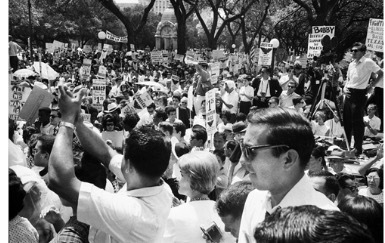
Labor Day Climax To the Long Farmworkers' Marcha September 5th, 1966, Labor Day climax to the long farmworkers' Marcha included Black civil rights and white union activists that would unite their integrated demands for a $1.25 hourly minimum wage increase. B.T. Bonner’s delegation from East Texas joined members of the Austin NAACP at the capitol rally, as did the Texas AFL-CIO. All three groups-Blacks from East Texas, browns from South Texas, and white leaders of organized labor would unite under the $1.25 minimum hourly wage. As the march wound toward San Antonio and eventually to Austin, the civil rights struggle in East Texas would begin to bubble over time. Source: Austin American-Statesman Photographic Morgue (AR.2014.039), Austin History Center, Austin Public Library, Texas, Image AS-66-55186-A-16a. Blue Texas: The Making of a Multiracial Democratic Coalition in the Civil Rights Era, Max Krochmal (2016). Creator: Austin American-Statesman Date: September 5th, 1966.
Rev. Claude Black, W. J. Durham, Henry Muñoz, and Moses LeRoy Address Wooldridge Square Park
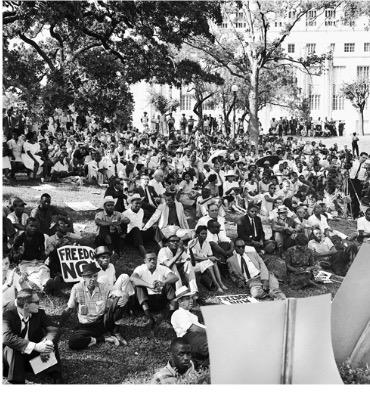
Rev. Claude Black, W. J. Durham, Henry Muñoz, and Moses LeRoy Address Wooldridge Square Park After the march, a large crowd assembled at Woolridge Square Park to hear speeches by Rev. Claude Black, W. J. Durham, Henry Muñoz, and Moses LeRoy. Each speechmaker pointed to the multiracial protest as evidence of the moment's remarkable unity across the color line as well as grouping together the importance that came with the Democratic Coalition and its conflict with the UPO. The UPO and the conservative African American professionals will ally with Governor Connally. Influential leader Moses LeRoy took the stage and addressed his take on the last decades of activism being in the trenches. Source: Austin American-Statesman Photographic Morgue (AR.2014.039), Austin History Center, Austin Public Library, Texas, Image AS-63-42087-06a. Blue Texas: The Making of a Multiracial Democratic Coalition in the Civil Rights Era, Max Krochmal (2016). Creator: Austin American-Statesman Date: 1960s

Location

Map

Metadata

Jonathan R. Konchak, “Booker T. Bonner: Leader, Educator, Believer, & Observer,” East Texas History, accessed October 1, 2026, https://easttexashistory.org/items/show/374.