Filed Under Anti-Feminism

National Women's Conference, 1977
Feminists and anti-feminists from across the United States descended on Houston, Texas in November 1977 to offer support or opposition to the National Women’s Conference.

“They should open some of the men’s restrooms to women, since there is hardly anyone here to use them,” suggested a National Women’s Conference delegate. A friend retorted, “Don’t you suggest it, some anti-ERA [Equal Rights Amendment] delegate will start hollering, ‘see I told you so; those ERA folks want unisex toilets!’” From 1977 to now, debates concerning women’s spaces, rights, and liberation have been contentious topics at the heart of American legislation. However, the National Women’s Conference of 1977 is decidedly the event that altered the fabric of American politics. Those present and those who have studied the conference’s outcome largely agree that those four days at the Sam Houston Coliseum were critical for America.

Feminists and anti-feminists from across the United States descended on Houston, Texas, to support or oppose the National Women’s Conference legislative goals that sought equality, equity, and liberation for American women. The conference intended to create and utilize an official platform that supported women’s rights and a progressive political agenda in the following decades. However, due to the multitude of caucuses that flooded the conference, a sea of demands stalled progress and created in-fighting amongst the various groups. From ethnic group caucuses to student-athletes to sex workers and members of Congress, everyone sought a seat at the table to address the institutional inequality of women in all corners of American society.

Feminist scholar Margorie J. Spruill has called the National Women’s Conference “the crest of the ‘second wave’ of American feminism.” The Sam Houston Coliseum hosted a “who’s who” of Democratic, leftist, and radical activists, including Gloria Steinem, Barbara Jordan, Betty Friedan, and Billie Jean King, to influence the advancement of women’s and feminist issues. At the same time, the conference also platformed the notable conservatives Phyllis Schlafly, Representative Bob Dornan, Nellie Gray, and Lottie Beth Hobbs. Schlafly’s impressive rise on the right, underscored by her successful anti-feminist campaigning efforts leading up to and during the conference, drew unexpectedly large crowds of Christian and conservative women. Universally remembered for her bravado and insistence on thanking her husband for “allowing” her to attend the conference, Schlafly became a conservative icon overnight. Like Schlafly, other conservative opponents of progressive women’s legislation surprisingly found their niche at an event previously hailed as one of the most important political conferences for women in the twentieth century. Unfortunately, propaganda ran amuck in the days leading to the conference.

In response to the calls to action, prominent Black journalist Carl T. Rowan denigrated conservatives' so-called “Pro-Family Coalition” rhetoric as divisive “hang-ups” about individuals’ orientation, religion, and political affiliation. Rather than bringing women together to seek a brighter future, the National Women’s Conference left Houston, Texas, awash with contentious politics, pitting women against women, Black against White, straight against gay, and liberal against conservative. The result of the conference, the National Plan of Action, initially determined to influence the trajectory of women’s politics well into the 1990s, fell flat in the face of conservatism. Yet, in a somewhat surprising turn of events, conservative political objectives found success after the conference. Responsible for the rise of anti-woman rhetoric that encapsulated the 1980s and the diminishment of the progress created during the 1960s and 70s, the National Women’s Conference helped birth the “pro-family” movement during the Regan administration. The conference inadvertently brought opposing forces together and cemented the watershed moment that irreparably fractured American politics.

Images
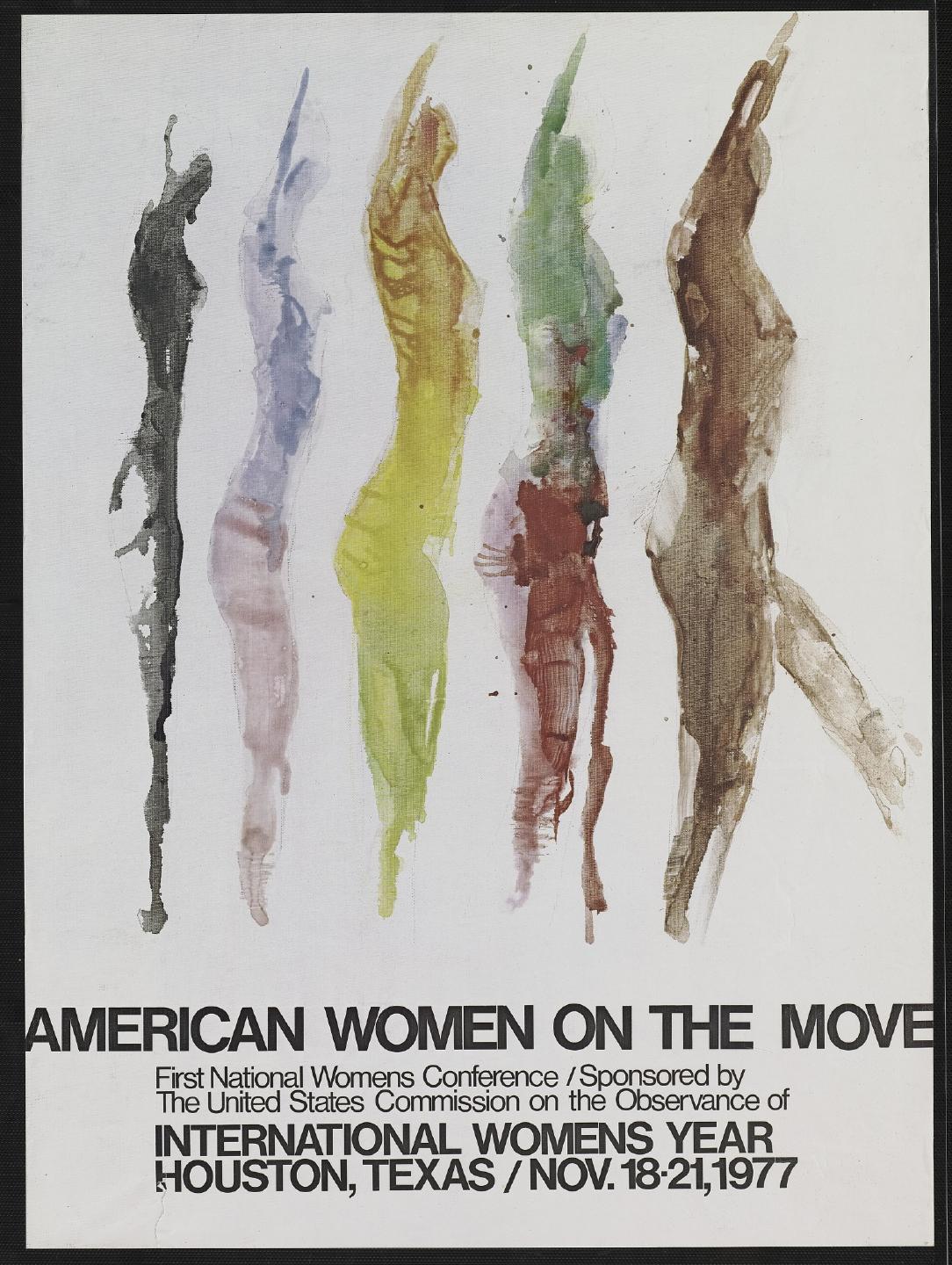
The official poster of the 1977 National Women’s Conference
The official poster of the 1977 National Women’s Conference The artistic rendering of women's bodies signifies the diversity of the National Women's Conference. Created by Houston-based artist Dottie Erwin, the poster became an iconic symbol of the NWC. However, while art and expression were essential elements to disseminating the political messages of the conference, it was unable to bridge the gap between white feminists and women of color. During the four days of the conference, opposing viewpoints were negotiated between the white majority and minority women; poverty, sexual harassment, employment disparities, racism, and institutional access were also addressed. Ultimately, the various caucuses presented proposals to remedy these social inequities and found success at the close of the conference. Source: Smithsonian, National Museum of American History https://americanhistory.si.edu/creating-icons/national-women’s-conference-1977 Creator: Dottie Erwin Date: November 1977
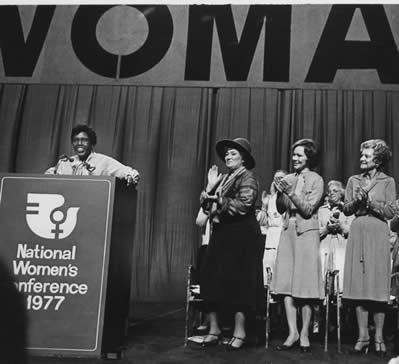
Barbara Jordan speaks at the National Women's Conference in Houston.
Barbara Jordan speaks at the National Women's Conference in Houston. Barbara Jordan is the first Black woman elected to a state senate seat in Texas after Reconstruction. Jordan was a prominent Civil Rights activist during the 1960s and 70s and one of the first Black women to win a seat in the House of Representatives. At the National Women's Conference, Jordan spoke out about inequality, Black rights, and the importance of progressive politics. During her keynote speech, Jordan demanded that women gain access to political, social, and economic equity, the same as men. She also directed conference-goers attention to the need for peace between nations and espoused values that supported human rights across the globe. Rather than focusing specifically on American women, Jordan's feminism was expansive and considered women from all parts of the world. Source: https://digital.library.sc.edu/exhibits/iwy/
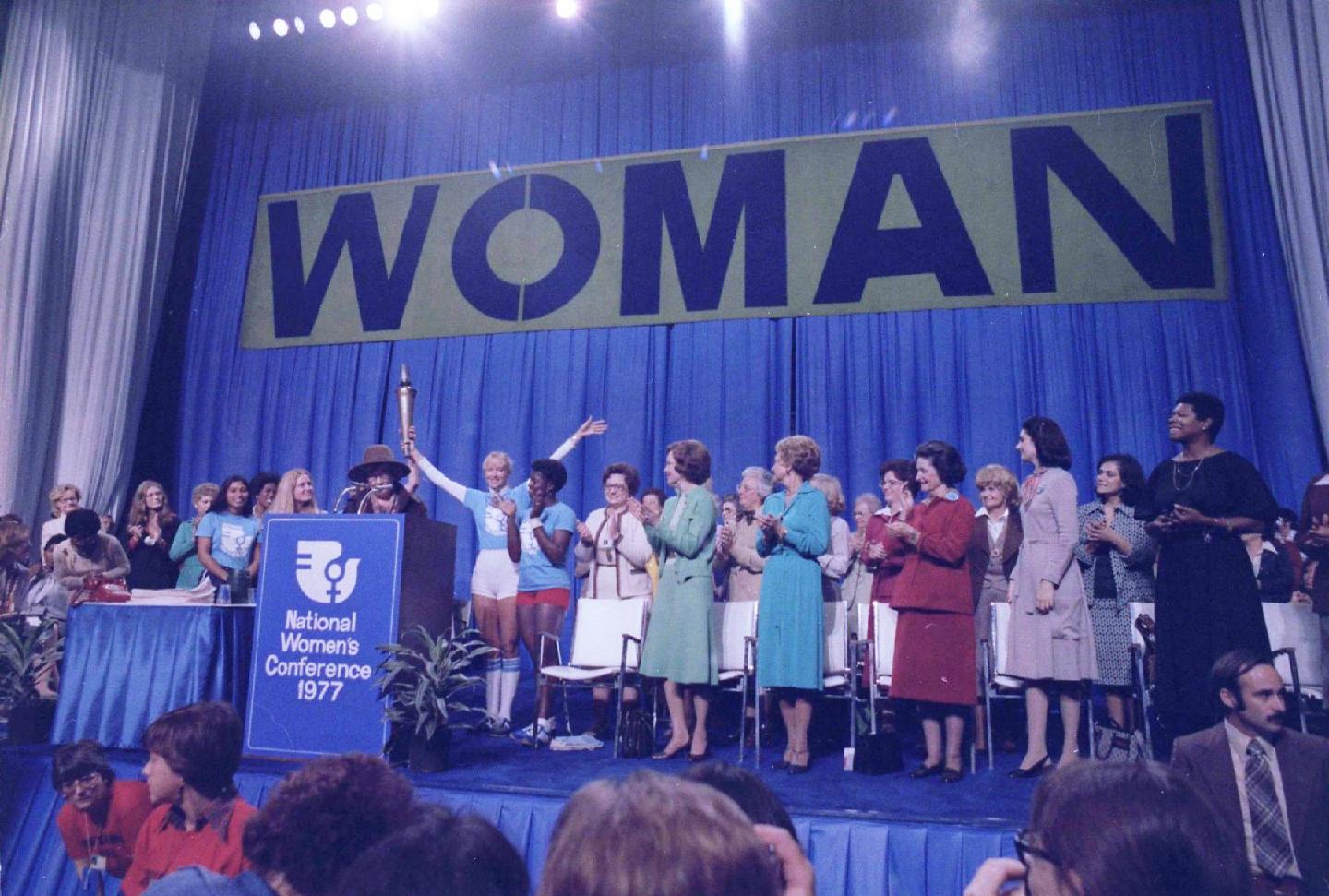
The First Ladies
The First Ladies During the National Women's Conference, three First Ladies attended and supported the political goals of the forum. First Lady Rosalynn Carter and former First Ladies Lady Bird Johnson and Betty Ford addressed the conference, supporting women's liberation, reproductive rights, and abortion access. Their appearance demonstrated the high levels of bipartisanship provided by the American government. This photo also captures conference commissioner Bella S. Abzug's opening speech and the diversity of women represented by the delegates. The large "WOMAN" sign in the background illustrates the conference's empowering "pro-woman" message. However, conservatives stalled the action plan and ultimately diminished the liberal agenda of the forum. Source: https://digital.library.sc.edu/exhibits/iwy/ Date: November 18, 1977
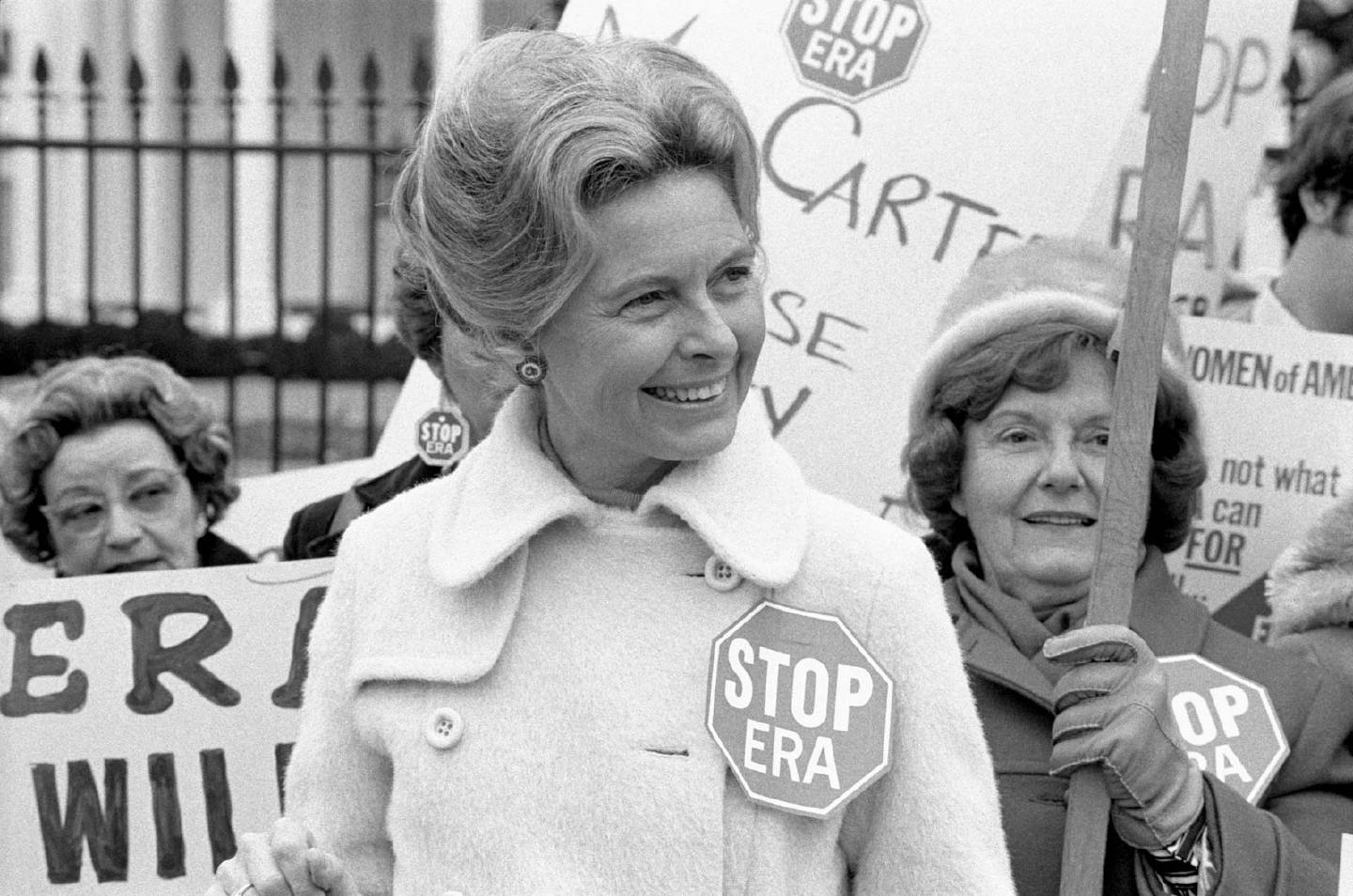
Phyllis Schlafly leads the charge against the ERA in Houston.
Phyllis Schlafly leads the charge against the ERA in Houston. Phyllis Schlafly played a central role in the rise of the Christian Right in American politics. Schlafly ran for the Illinois senate in 1955 and again in 1970 but lost both races. However, the losses did not stop her rise to prominence on the Right. Public interest in the traditionalist helped her amass support from a diversity of nonpartisan networks across the country. Through her work as chairman of National Defense for the Daughter of the Revolution, a group that traced its roots to the Revolutionary War, and as president for the Illinois chapter of The National Federation of Republican Women, she became a notable public speaker on the conservative circuit. However, following several bitter political losses and snubs from senior GOP members, Schlafly started her own ultra-conservative movement and publication, The Phyllis Schlafly Report, in 1967. Source: https://www.houstoniamag.com/news-and-city-life/2018/01/1977-national-womens-conference-houston Date: November 1977
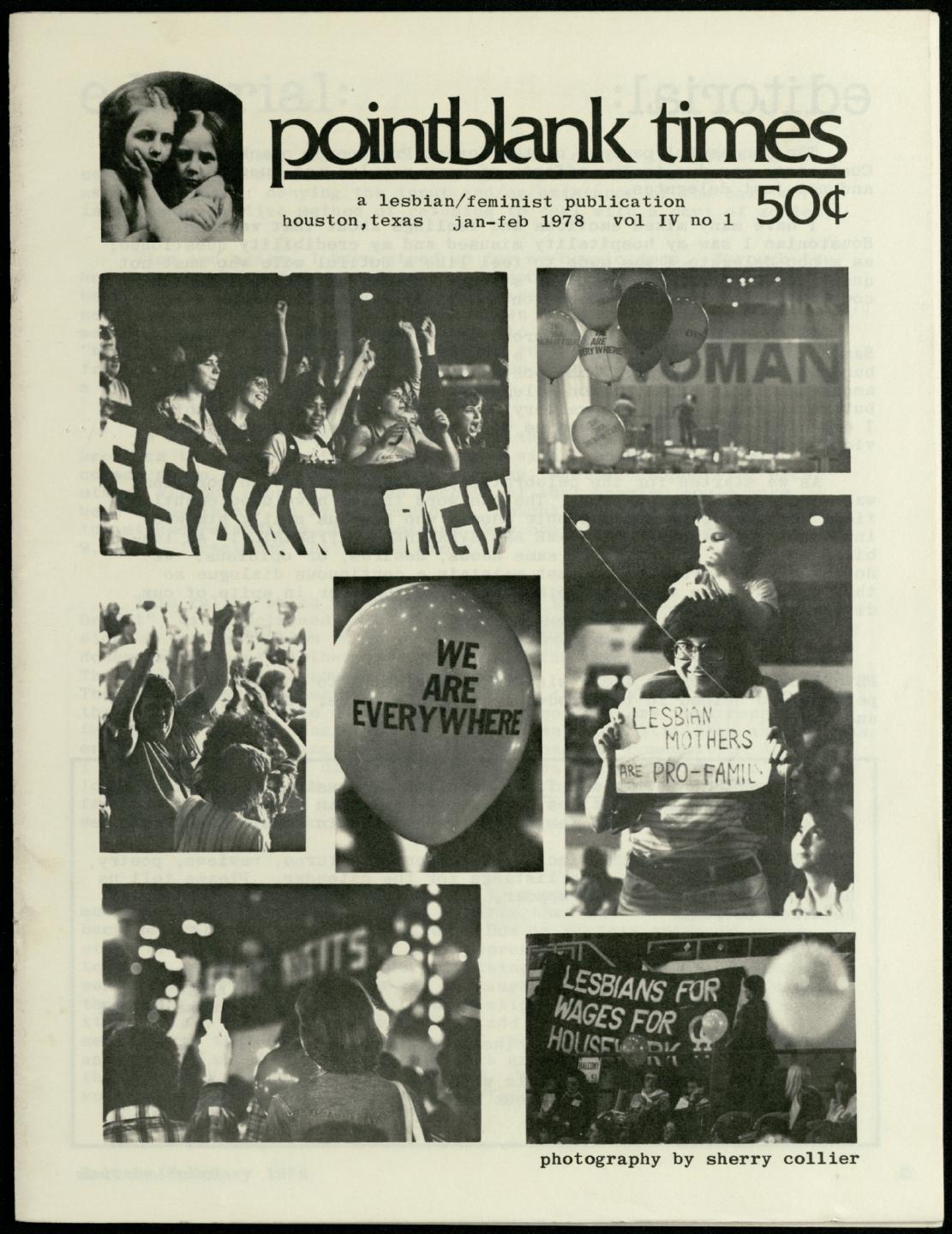
Pointblank Times cover, Jan-Feb 1978
Pointblank Times cover, Jan-Feb 1978 Pointblank Times Magazine was a Houston-based feminist/lesbian publication that printed essays, poetry, op-eds, and local news from 1975-1978. Featuring the work of lesbian activists and artists, the magazine highlighted the emergent queer culture of Houston and emphasized the importance of women's liberation. Following the National Women's Conference, Pointblank Times printed photos and accounts from the conference. This particular issue of the magazine celebrated the recognition of lesbians as important, contributing members to women's liberation during the National Women's Conference.  Source: Pointblank Times, Vol. 4, No. 1, January 1978 - February 1978 - Page 1, January 1978 - February 1978, Houston and Texas Feminist and Lesbian Newsletters, Special Collections, University of Houston Libraries, accessed September 27, 2021, https://digital.lib.uh.edu/collection/feminist/item/4005/show/3973. Creator: Pointblank Times Date: January/February 1978
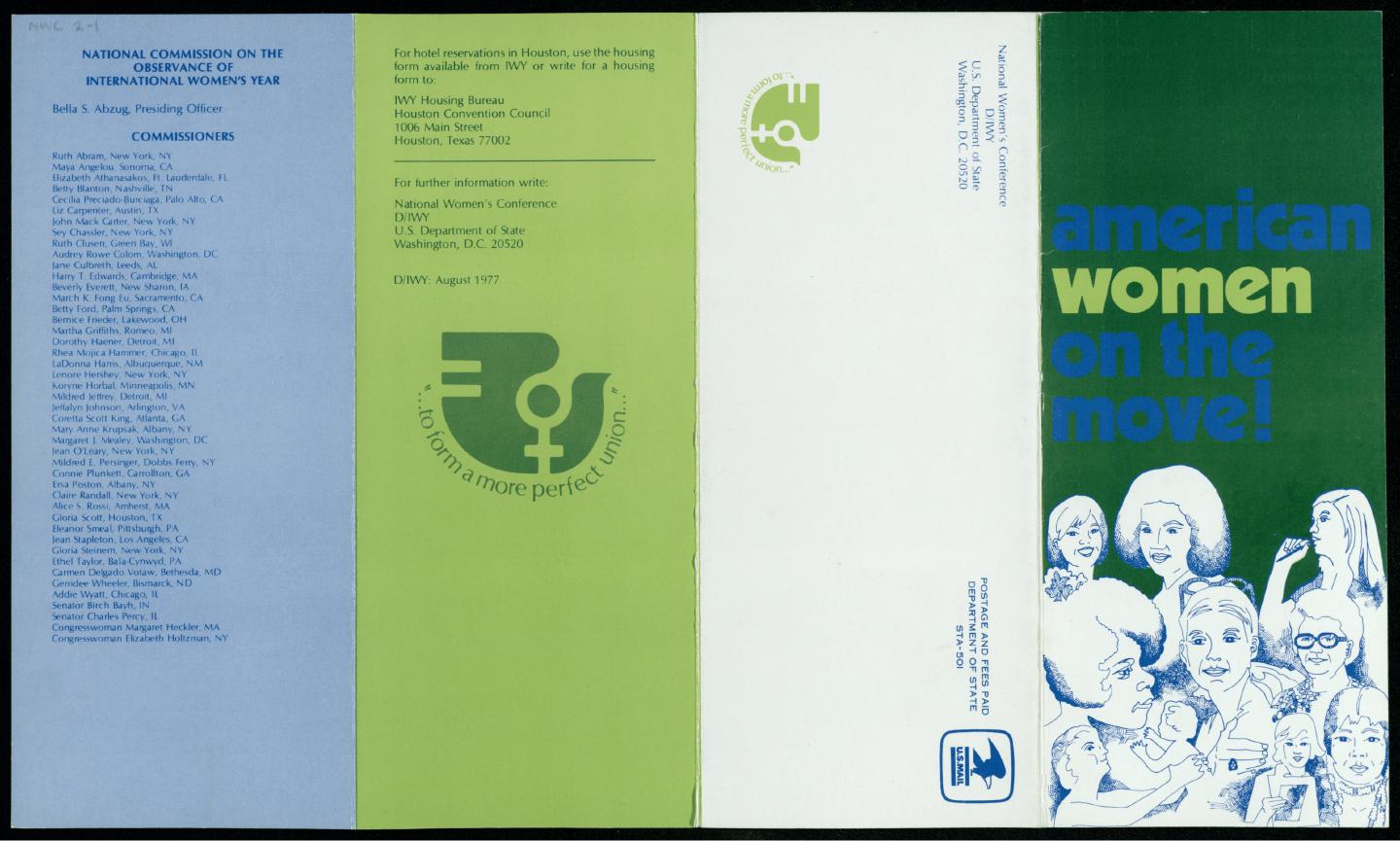
American Women on the Move, official conference pamphlet.
American Women on the Move, official conference pamphlet. "Women on the Move" Pamphlets were sent from Washington, DC across the country to prompt interest in the National Women's Year Conference taking place in Houston, Texas. Offering a space for women of all backgrounds to "get political," the conference encouraged diversity and inclusion decades before "diversity" and "inclusion" were buzzwords in contemporary American culture. Congress member Bella S. Abzug oversaw the development and dissimination of information for the conference. She was also among the keynote speakers to open the conference and introduce the various guests and agendas over the course of the event. Source: US State Department Creator: National Women's Conference Date: November 18-21, 1977

Location

Map

Metadata

Casey Renée Lopez, “National Women's Conference, 1977,” East Texas History, accessed October 1, 2026, https://easttexashistory.org/items/show/356.