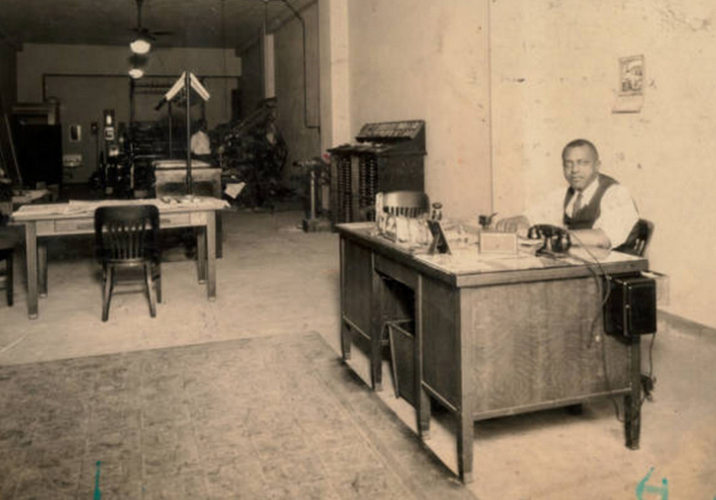
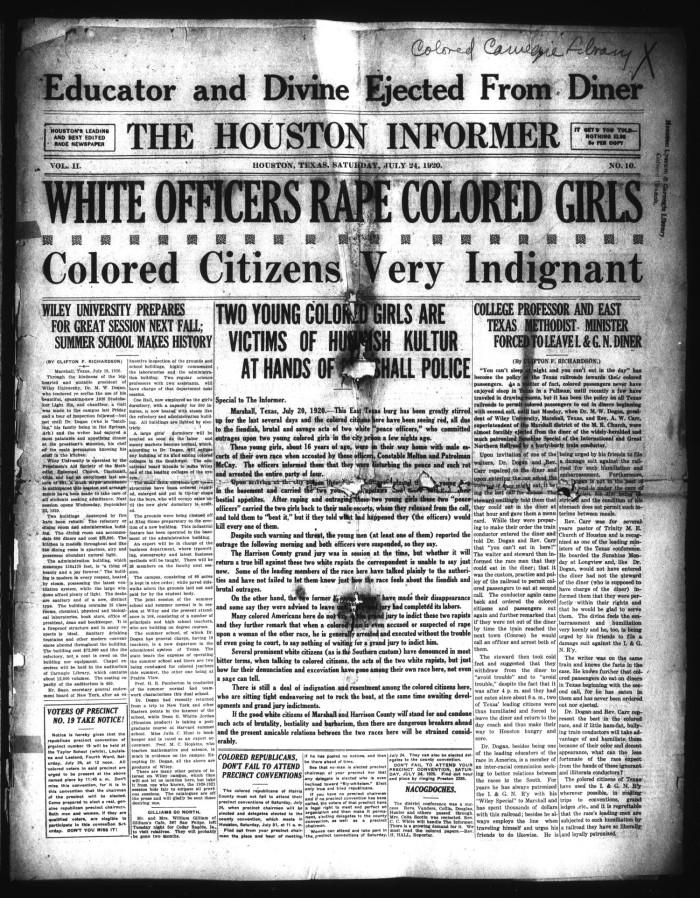
C.F. Richardson's Houston Informer
Clifton Frederick Richardson, Sr., better known as C.F. Richardson, was born in 1891 and raised in the town of Marshall, Texas. A graduate of Bishop College, he moved to Dallas in 1909 to work for the Dallas Express, a black-owned newspaper, before moving to Houston in 1910 to work for the Western Star. In 1916, Richardson became a journalist and editor at the Houston Observer, a newspaper he started with three business partners. However, it was not until three years later that he would be the founder of a publication that would become synonymous with the fight for civil rights in Houston. In May of 1919 the weekly newspaper, the Houston Informer was launched. The financial backing had come from Hobart Taylor, Sr. a Houston-based millionaire and Richardson steered the newspaper’s mission as editor.
The Informer was one of several black-owned newspapers in circulation during the 1920s, one of four in Texas alone. Through it, Richardson vocalized the issues and concerns of America’s African-American Community to great effect, advocating for equality and an end to racially motivated violence. Although these types of protest actions were apparent in other black-owned newspapers, what set the Houston Informer apart was Richardson’s belief in Texas. Unlike the Chicago Defender or the Crisis, the Houston Informer did not promote a better life in the north. As a response to the constant evocations of a more equal society in the North, Richardson wrote the article "Why I Stay in Texas and Fight" for the Pittsburgh Courier, where he argued that only by staying in Texas would African Americans be able to effect change. Richardson also ensured the Informer differentiated itself from its competitors by remaining non-partisan. This was at a time when most African Americans tended to support the Republican Party. As far as Richardson was concerned, neither political party had done much to help black Texans with their goal of racial equality.
At its peak, the Informer was the leading black-owned newspaper in Texas, with more than sixteen thousand subscribers. Richardson capitalized on the newspaper’s position by continuously advocating for racial pride and equality for black Americans. During the 1920s Richardson was also involved in numerous campaigns to improve the quality of life for the African American community in Houston. This included better educational facilities and more parks within the black neighborhoods. He regularly compared the services available to white residents and black residents. Partly this was an effort to mobilize black residents into action, partly it was to force a response from Houston’s city leaders.
During his career, Richardson used the space afforded him in the newspaper to criticize the nation for the continued violence against African Americans. These kinds of editorials placed Richardson and the paper in the crosshairs of white supremacists and segregationists. As a result, there are accounts of alleged plots by members of the Klu Klux Klan to murder him. Despite these threats, Richardson continued to campaign for improvement to the quality of life for Houston’s African American community. This was a remarkable act of bravery considering the political strength the Klan had in Texas during the first half of the twentieth century. In the 1920s, the Klan’s sphere of influence in Houston was so great that it counted prominent members of the community among its members, including Gordon Murphy, Houston’s police chief. In addition to threats of violence against Richardson, the offices of the Houston Informer were vandalized, and equipment was destroyed after Richardson published opposition to the political appointment of a Klan member.
C.F. Richardson’s fight for equality in Houston was relentless. In 1923, the abolishment of a bus line for African Americans led to the Houston Informer publishing a scathing editorial on the city council’s continued suppression of its African American community. In 1924, Richardson used his voice to denounce the city for building a zoo in the predominantly white neighborhood while ignoring the need for many basic services in Houston’s black neighborhoods. At the core of all the issues facing African Americans in Houston, Richardson believed, was the continued efforts by the city council to mute their voices. By not allowing African Americans to be part of mainstream society in Houston, the council was able to willfully suppress them and prioritize the needs of white Houstonians over their black neighbors.
The strategy to use the Houston Informer to hold the city officials to account seemed to affect change in the city. Towards the end of the 1920s improvements began to be made in some of the African American neighborhoods around the city, including better roads. There was also a gradual improvement in education facilities. While Richardson had railed against the segregated schooling system, he also acknowledged and thanks officials for designating approximately a quarter of a million dollars to improve the facilities at three of Houston’s African American schools.
Many of Richardson’s campaigns and successes were achieved at a relatively young age. He had become founder and editor of the state's most successful black newspaper, and one of the most powerful voices for civil rights in Texas, yet he was still only in his mid-thirties. Richardson’s vision for racial equality went beyond Houston’s city limits and through his work, he called upon all African Americans to present a united front. He believed that only through unity and achievement would African Americans truly be able to obtain equality.
By the time C.F. Richardson died in 1939, he had become one of the most important figures in Houston’s civil rights history. Through his work at the Houston Informer, Richardson had been able to fight for Houston’s black population while simultaneously providing counsel to his readers. A believer in racial pride, Richardson often advised his readers to become more involved in local politics, to help themselves rather than waiting on the city’s officials, and to work together to break down the barriers of segregation. While C.F. Richardson did not live to see the Civil Rights Act become law, his work contributed to the foundations of the civil rights movement.
Images