Fort Parker State Park
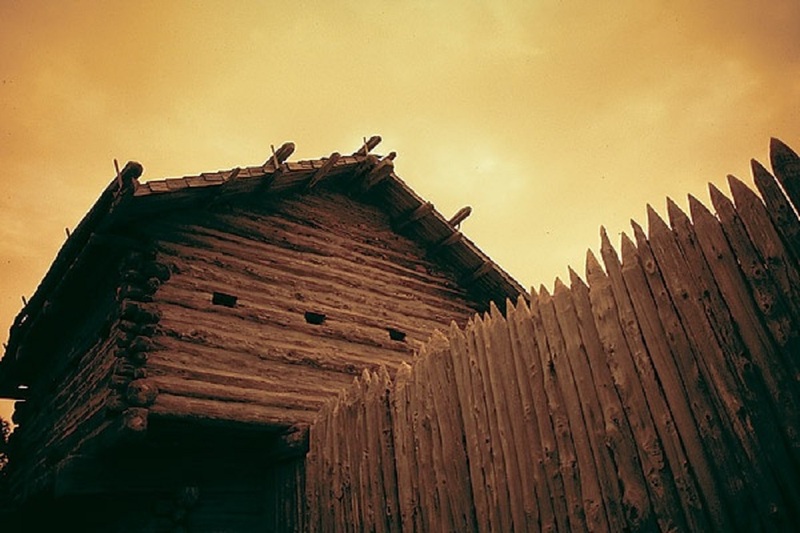
Two months after the Battle of the Alamo, another massacre took place on the Texas frontier. On May 19, 1836, hundreds of Native Americans ambushed Fort Parker near present day Mexia, Texas. In 1833, a group of Predestinarian Baptists left Illinois in twenty-five ox-drawn wagons. Many members of this group, including Elder John Parker and his family, settled near the Navasota River in East Texas. Upon arrival, the Parker men began constructing "Parker's Fort" out of fifteen-foot tall split cedars.

Three years later, on that fateful morning, hundreds of Comanche and Kiowa approached the fort waving a white flag. The Comanche stabbed Elder Parker’s son Benjamin when he approached the group. The Comanche and Kiowa charged the fort and killed four more men, wounded three women, and took five women and children captive. Elder Parker’s son, Daniel wrote of the massacre in the family Bible, which is currently on display in the Elkhart State Bank in Elkhart, Texas. Among those taken captive was a nine-year-old girl, Cynthia Ann Parker. James Parker, Cynthia’s uncle, unsuccessfully petitioned Sam Houston to send troops to recover the captives several times.

Cynthia remained with the Comanche for twenty-four years. In 1860, Captain Lawrence Sullivan "Sul" Ross led the Texas Rangers in a surprise attack against the Comanche in the Battle of Pease River where he discovered and recaptured Cynthia. Sul Ross would later become Governor of Texas and President of Texas A&M University.

Later, the area became Springfield, Texas, a dusty frontier town. Springfield was Limestone County's first county seat in 1847. The only visible reminder of Springfield that remains is a small cemetery found inside of Fort Parker State Park. Inside the cemetery is the grave of a veteran of the American Revolution.

In 1935, the Civilian Conservation Corps (CCC) built a camp in the area. Fort Parker CCC Camp housed Company 3807. The company was a segregated unit. Most of these men were sons of black Texas sharecroppers. As part of the Texas Centennial of 1936, Company 3807 reconstructed Fort Parker as closely to the original as possible. This reconstructed fort lies just over two miles outside of Fort Parker State Park, which Company 3807 also built. Former Texas Governor Pat Neff, who started the state parks effort in the 1920s, dedicated Fort Parker State Park in May 1941, and declared it open to the public. Sadly, after completing the work there, the men of Company 3807 could not visit the park. There was a statewide policy of banning all blacks from state parks in Texas until the 1960s.

Fort Parker State Park is a rare location that combines recreation and conservation with history and heritage. Fort Parker and Fort Parker State Park represent American frontier life, Native American history, African American history, and the history of the Great Depression and the New Deal.

Audio

"We Built that Dam" Willis Slaughter, a member of CCC Company 3807, takes pride in his role in constructing Fort Parker State Park. Source: Texas Parks and Wildlife Department
A Nationwide System of Parks, 1939 The Department of the Interior describes the role of the CCC in building the nation's parks. Source: National Archives and Records Administration

Images

Old Fort Parker
Old Fort Parker This reconstructed fort honors the Parker family and other pioneers who settled in Texas. As a Texas Centennial project in 1936, the fort was reconstructed by the men in Company 3807 of the Civilian Conservation Corps. In 1967, the fort was reconstructed again by convicts from Huntsville, Texas. Source: Texas Parks and Wildlife Department
Cynthia Ann Parker with daughter Topsannah
Cynthia Ann Parker with daughter Topsannah Cynthia was captured in the Comanche raid of Fort Parker in 1836. Cynthia remained with the Comanche for twenty four years; she married Chief Peta Nocona and had three children. In 1860, Cynthia and her baby daughter, Topsannah or Prairie Flower, were recaptured and put in the custody of her uncle, Isaac Parker. Cynthia tried to escape several times and return to her sons Quanah and Pecos. Every year, on the third Friday of July, members of both branches of the Parker Family gather at Fort Parker State Park for a reunion. Source: Denver Public Library
Quanah Parker in Occidental Dress
Quanah Parker in Occidental Dress Cynthia Parker's son, Quanah Parker, was the last great Comanche chief. Quanah took part in the Battle of Palo Duro Canyon and was a great warrior. Quanah worked much of his life to bridge the gap between the two worlds of his mother and father during a time when the Comanche were moved to reservations and forced to assimilate. A town in North Texas is named after the chief. Quanah usually wore traditional Comanche dress. Source: National Anthropological Archives, Smithsonian Institution
Quanah's Letter to Governor Campbell
Quanah's Letter to Governor Campbell Cynthia Parker was buried in East Texas, but Quanah petitioned to have her body moved to the Post Oak Cemetery near Cache, Oklahoma in 1910. In 1957, her body was moved one more time to be buried next to Quanah at Fort Sill in Oklahoma. Source: Texas State Library and Archives
Civilian Conservation Corps (CCC) Company 3807, c. 1935
Civilian Conservation Corps (CCC) Company 3807, c. 1935 These men were stationed at Fort Parker CCC Camp. Construction of Fort Parker State Park lasted from 1935 until 1942. These men built many facilities for the 1,400 acre Fort Parker State Park: the dam, a bath house, a boathouse, roads, cement picnic tables, drinking fountains, and a clubhouse. Company 3807 was the only all black unit in the district to receive a superior rating and earned it twice by October 1940. Source: Texas Parks and Wildlife Department
Dam Construction, Fort Parker State Park, c. 1937-1938
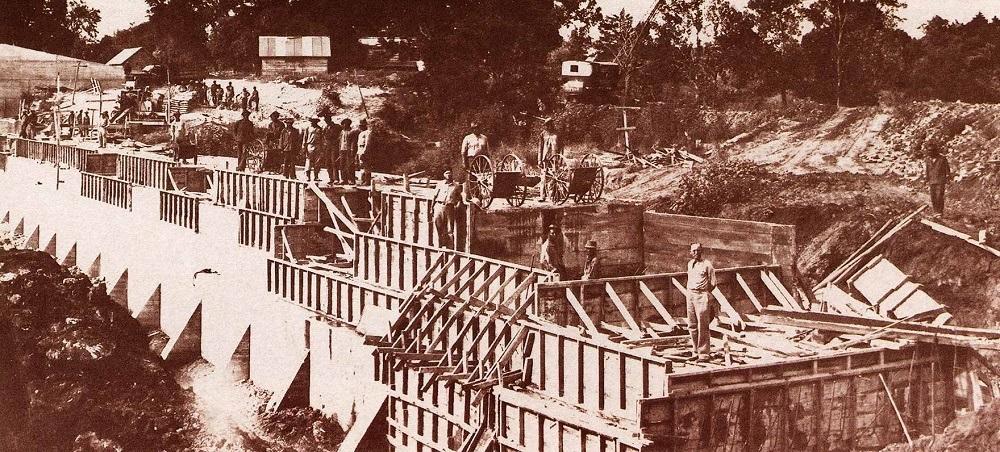
Dam Construction, Fort Parker State Park, c. 1937-1938 Here the dam is nearing completion. This photo offers a glimpse into the process of dam construction, Visible are stacked cement sacks, a concrete mixer, and "Georgia buggies" or wheelbarrows used to haul rocks and cement. Source: Texas Parks and Wildlife Department
Men Pose on the Dam, c. 1938
Men Pose on the Dam, c. 1938 Civilian Conservation Corps Company 3807 built a 423 foot concrete dam on the Navasota River in order to create 750 acre Fort Parker Lake, which was also known as Springfield Lake. This demanding work required blasting and hauling rock for cement, and a lot of digging. Most of this work was done by hand with pickaxes, shovels, and wheelbarrows. Source: Texas Parks and Wildlife Department
Navasota River Dam
Navasota River Dam This dam created Lake Fort Parker and was finished in 1938. This dam was 58-feet tall from the footings to the top and used 5,600 cubic yards of concrete. In Texas, the Civilian Conservation Corps built 56 state, national and local parks. More than 1,000 park buildings, features and structures stand today, managed by the Texas Parks and Wildlife Department. Source: Larry D. Moore, www.livingnewdeal.org
The Mexia Weekly Herald, May 2, 1941
The Mexia Weekly Herald, May 2, 1941 The Fort Parker State Park opening was a well-attended event with many notable guests. Pictured here is an announcement that Gerald Mann would interrupt his senatorial campaign in order to attend. Mann ran for Senate in 1941 against Lyndon B. Johnson and the winner, Governor Pappy O'Daniel, the only person to ever beat Johnson in an election. This important local news shares the front page with other fascinating stories that offer a snapshot of world events in 1941. Source: Portal to Texas History, University of North Texas
Fort Parker Civilian Conservation Corps (CCC) Reunion
Fort Parker Civilian Conservation Corps (CCC) Reunion A few men from Company 3807 gathered at Fort Parker State Park in 1993 to reminisce about their time in the CCC. This historical marker commemorates the CCC camp at Fort Parker. Roughly 5,000 African Americans worked for the CCC in Texas. Originally, CCC camps were integrated, but by 1935, they were separated into "white" and "colored" camps. Source: Texas Parks and Wildlife Department

Location

Map

Metadata

Rachael Larkin, “Fort Parker State Park,” East Texas History, accessed October 1, 2026, https://easttexashistory.org/items/show/122.