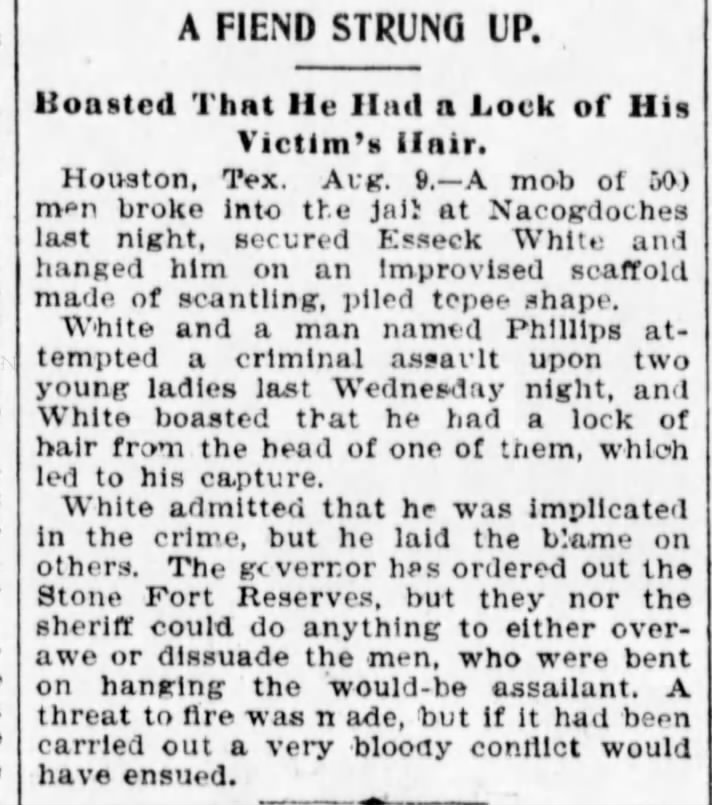
Public perception and broader national stereotypes of African American men attacking white women, in fact, escalated mob violence, such as in the case of White. During the mid-nineteenth century, caricatures of African Americans circulated rapidly to first justify slavery and then to justify oppression and the rise and entrenchment of Jim Crow segregation laws. The “Brute” and “Mandingo,” for instance, along with “fiend” and “brute,” were portrayals of African American men as overly aggressive, violent, and hypersexual predators. Such racist images and stereotypes, along with others such as the “Mammy” and “Uncle Moses” were ingrained in Southern society, dehumanizing and devaluing African American lives so that they did not matter. So, when Esseck White was accused of rape, he sadly and quickly died at the hands of angry white Nacogdocheans not content to allow the democratic, constitutional laws and principles of the nation to unfold. | Date: August 10, 1897 | Source:
A Fiend Strung Up," Scranton Tribune (PA), August 10, 1897, p. 1.